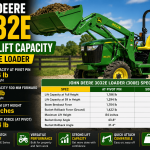
The John Deere 3025E with a 300E loader can lift 1,186 lb at the pivot pin, or 845 lb at 500 mm forward of the pivot, to full height.
John Deere 3025E Loader Lift Capacity
| Tractor Model |
John Deere 3025E |
| Loader Model |
John Deere 300E front loader |
| Max Lift Height |
84 in / 2,140 mm |
| Lift Capacity to Full Height – Pivot Pin |
1,186 lb / 539 kg |
| Lift Capacity to Full Height – 500 mm Forward |
845 lb / 384 kg |
| Lift Capacity at 59 in – Pivot Pin |
1,294 lb / 588 kg |
| Lift Capacity at 59 in – 500 mm Forward |
977 lb / 444 kg |
| Boom Breakout Force – Pivot Pin |
1,704 lb / 760 kg |
| Boom Breakout Force – 500 mm Forward |
1,204 lb / 537 kg |
| Bucket Rollback Force at Ground |
1,422 lb / 634 kg |
| Loader Base Weight |
675 lb / 306 kg |
| Bucket Used in Specs |
61 in / 1,550 mm materials bucket |
| Bucket Weight |
205 lb / 93 kg |
How Much Can a John Deere 3025E Loader Lift?
The John Deere 3025E with the 300E loader can lift 1,186 lb at the pivot pin to full height. The more useful real-world number is 845 lb at 500 mm forward of the pivot, because real loads sit forward in the bucket or on pallet forks.
At a lower 59 inch lift height, the loader is stronger: 1,294 lb at the pivot and 977 lb at 500 mm forward.
Use the 500 mm forward rating for real work. Pivot-pin numbers look better, but they are not the honest number for buckets, forks, logs, pallets, or material sitting forward from the pins.
Quick Loader Specs Overview
1,186 lbFull Height Pivot
845 lbFull Height Forward
84 inMax Lift Height
1,704 lbBreakout Force
300E Loader Lift Capacity Chart
Pivot Full Height
1,186 lb
Forward Full Height
845 lb
Real-World Lifting: What the 3025E Can Actually Handle
| Mulch Bucket |
Yes, easy normal use |
| Topsoil Bucket |
Yes, but wet soil gets heavy fast |
| Gravel Bucket |
Partial buckets are smarter; full buckets can overload it |
| Pallet Forks |
Useful for light loads, but capacity drops because the load sits forward |
| Round Bale |
Not ideal; depends heavily on bale weight, spear position, and ballast |
| Logs |
Good for smaller logs; large wet logs can overload it |
| Small Implements |
Good if weight stays within the forward-load rating |
Do not treat the 3025E like a skid steer. It is a compact tractor loader. It is useful, but the tractor is light and needs proper rear ballast.
3025E Tractor Specs That Affect Loader Performance
| Engine Power |
24.7 hp / 18.2 kW gross |
| PTO Power |
19.4 hp / 14.4 kW |
| Hydraulic Type |
Open center |
| Steering Hydraulic Flow |
4.0 gpm / 15 L/min |
| Implement Hydraulic Flow |
5.3 gpm / 20.2 L/min |
| Total Hydraulic Flow |
9.3 gpm / 35.2 L/min |
| Hydraulic Pressure |
2,500 psi / 172.4 bar |
| Rear 3-Point Lift |
1,356 lb / 615 kg at 24 in behind link arms |
| Transmission |
Hydrostatic transmission |
| Approx. Open-Station Shipping Weight |
2,222 lb / 1,008 kg |
Loader vs Rear Lift Capacity
Rear 3-Point Lift
1,356 lb
Loader Pivot Lift
1,186 lb
Loader Forward Lift
845 lb
300E Loader Dimensions
| Maximum Lift Height |
84 in / 2,140 mm |
| Bucket Level at Full Height |
78 in / 1,979 mm |
| Bucket Dumped at Full Height |
63 in / 1,596 mm |
| Reach at Maximum Height |
27 in / 690 mm |
| Dump Angle at Maximum Height |
38 degrees |
| Rollback Angle at Ground |
30 degrees |
| Digging Depth |
3 in / 76 mm |
Best Uses for the 3025E Loader
- Moving mulch, compost, loose dirt, and garden material
- Light gravel and driveway maintenance
- Small property cleanup
- Moving firewood and smaller logs
- Using pallet forks for light pallets and attachments
- Snow removal with bucket or front blade setup
Not Best For
- Regular heavy round bale handling
- Full buckets of wet gravel or wet clay
- Commercial earthmoving
- Heavy pallet work at full height
- Replacing a skid steer or backhoe loader
Ballast: The Part People Ignore
Loader capacity is not just about what the loader can lift. The tractor also needs enough rear ballast to stay stable and safe.
Best practical setup: loaded rear tires plus a ballast box, heavy rear implement, or proper 3-point counterweight when doing serious loader work.
| No Rear Ballast |
Bad idea for serious loader work |
| Loaded Rear Tires |
Good baseline stability improvement |
| Ballast Box |
Best simple counterweight option |
| Rear Implement |
Good if heavy enough and mounted securely |
| Pallet Fork Work |
Needs extra care because load sits farther forward |
Common Mistakes
- Using the pivot-pin rating as the real lifting number
- Ignoring the 845 lb forward-load rating
- Lifting heavy loads without rear ballast
- Driving with the bucket raised high
- Using pallet forks and forgetting capacity drops as load moves forward
- Trying to lift wet gravel or wet soil like it weighs nothing
- Assuming the 3025E loader performs like a skid steer
Summary
The John Deere 3025E with the 300E loader has a 1,186 lb pivot-pin lift capacity to full height and a more realistic 845 lb lift capacity at 500 mm forward. At 59 inches, it can lift 1,294 lb at the pivot or 977 lb forward. The 3025E also has a 1,356 lb rear 3-point lift capacity, 9.3 gpm total hydraulic flow, 2,500 psi hydraulic pressure, and an 84 inch maximum loader lift height. It is a capable compact tractor loader for property work, but it needs proper ballast and realistic expectations.