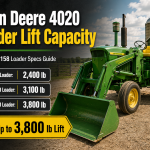
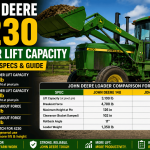
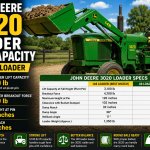
The John Deere 4430 loader lift capacity is about 3,100 lb with a 148 loader or 3,800 lb with a 158 loader, measured at full height at the pivot pin.
John Deere 4430 Loader Lift Capacity
| Tractor Model |
John Deere 4430 |
| Machine Type |
Row-crop tractor |
| Common Loader Models |
John Deere 148 loader and John Deere 158 loader |
| John Deere 148 Loader Lift Capacity |
3,100 lb / 1,406 kg at full height at pin |
| John Deere 158 Loader Lift Capacity |
3,800 lb / 1,723 kg at full height at pin |
| 148 Loader Breakout Force |
4,700 lb / 2,131 kg |
| 158 Loader Breakout Force |
5,000 lb / 2,268 kg |
| 148 Loader Lift Height |
126 in / 320 cm |
| 158 Loader Lift Height |
156 in / 396 cm |
| Best Real-World Number |
Use less than the pin rating for forks, bales, logs, pallets, and forward loads |
| Hydraulic System |
Closed-center |
| Hydraulic Capacity |
11 gal / 41.6 L, or 10 gal / 37.9 L with Power Shift |
| Hydraulic Pressure |
2,250 psi / 155.1 bar |
| Hydraulic Pump Flow |
22 gpm / 83.3 L/min |
| Rear 3-Point Lift |
4,550 lb / 2,063 kg |
How Much Can a John Deere 4430 Loader Lift?
The John Deere 4430 can lift about 3,100 lb / 1,406 kg at full height at the pivot pin with a John Deere 148 loader. With the larger John Deere 158 loader, it can lift about 3,800 lb / 1,723 kg at full height at the pivot pin.
The real-world working number is lower when using pallet forks, bale spears, grapples, or long loads. The farther the weight sits forward from the loader pins, the less the tractor can safely lift.
The pin rating is the headline number. It is not the same as pallet fork capacity. Forks move the load forward, so practical lift drops fast.
Quick Loader Specs Overview
3,100 lb148 Loader Lift
3,800 lb158 Loader Lift
5,000 lb158 Breakout
22 gpmHydraulic Flow
John Deere 148 vs 158 Loader Specs
| Loader Model |
Best Published Lift Capacity |
| John Deere 148 Loader |
3,100 lb / 1,406 kg at full height at pin |
| John Deere 158 Loader |
3,800 lb / 1,723 kg at full height at pin |
| Best For Lift Capacity |
John Deere 158 loader |
| Best For Height |
John Deere 158 loader |
| Best Common Pairing |
148 or 158, depending on mounts, tractor condition, and intended work |
| Main Difference |
The 158 is taller, heavier, and stronger than the 148 |
John Deere 148 Loader Specs
| Lift Capacity at Full Height |
3,100 lb / 1,406 kg at pin |
| Breakout Force |
4,700 lb / 2,131 kg |
| Lift Height at Pin |
126 in / 320 cm |
| Clearance with Bucket Dumped |
102 in / 259 cm |
| Clearance with Bucket Level |
121 in / 307 cm |
| Reach Dumped |
32 in / 81 cm |
| Dump Angle |
38 degrees |
| Rollback Angle |
11 degrees |
| Boom Cylinder Diameter |
2.5 in |
| Bucket Cylinder Diameter |
2.5 in |
| Loader Weight |
1,350 lb / 612 kg |
| Bucket Widths |
60, 72, 84, or 96 in |
| Bucket Capacity |
0.5 to 0.9 cu yd / 0.4 to 0.7 cu m |
John Deere 158 Loader Specs
| Lift Capacity at Full Height |
3,800 lb / 1,723 kg at pin |
| Breakout Force |
5,000 lb / 2,268 kg |
| Lift Height at Pin |
156 in / 396 cm |
| Clearance with Bucket Dumped |
132 in / 335 cm |
| Clearance with Bucket Level |
151 in / 383 cm |
| Reach Dumped |
32 in / 81 cm |
| Dump Angle |
37 degrees |
| Rollback Angle |
12 degrees |
| Boom Cylinder Diameter |
2.75 in |
| Bucket Cylinder Diameter |
2.5 in |
| Loader Weight |
1,771 lb / 803 kg |
| Bucket Widths |
60, 72, 84, or 96 in |
| Bucket Capacity |
0.5 to 0.9 cu yd / 0.4 to 0.7 cu m |
Loader Capacity Chart
John Deere 4430 Tractor Specs That Affect Loader Performance
| Engine |
John Deere 404 ci / 6.6L 6-cylinder diesel |
| Claimed PTO Power |
125 hp / 93.2 kW |
| Tested Drawbar Power |
104.99 hp / 78.3 kW |
| Tested PTO Power |
125.88 hp / 93.9 kW |
| Hydraulic Type |
Closed-center |
| Hydraulic Capacity |
11 gal / 41.6 L, or 10 gal / 37.9 L with Power Shift |
| Hydraulic Pressure |
2,250 psi / 155.1 bar |
| Hydraulic Pump Flow |
22 gpm / 83.3 L/min |
| Hydraulic Valves |
1 to 3 |
| Rear Hitch |
Category II |
| Rear Lift |
4,550 lb / 2,063 kg |
| Transmission Options |
Syncro-Range, Quad-Range, Power Shift, or creeper |
| Production Years |
1973 to 1977 |
| Weight |
9,732 to 11,350 lb depending on configuration |
Loader vs Rear Lift Capacity
Rear 3-Point Lift
4,550 lb
Real-World Lifting: What a 4430 Loader Can Handle
| Round Bales |
Yes, usually fine with the right spear and rear ballast |
| Large Square Bales |
Possible depending on bale weight, loader model, and ballast |
| Loose Hay / Straw |
Easy work |
| Manure |
Good loader job with proper bucket |
| Gravel |
Yes, but full buckets get heavy fast |
| Wet Clay / Wet Soil |
Use partial buckets; weight adds up fast |
| Pallet Fork Loads |
Useful, but capacity drops because the load sits forward |
| Logs |
Good for many farm logs, but long wet logs can overload the front end |
The 4430 is a strong tractor, but it is still not a telehandler or wheel loader. Fork loads, long logs, and forward-heavy attachments reduce safe lifting capacity fast.
Best Uses for a John Deere 4430 Loader
- Feeding hay and moving round bales
- Manure handling
- Loading loose material
- Moving dirt, gravel, and farm materials
- Handling pallets carefully with forks
- General farm cleanup
- Snow pushing and snow loading
Not Best For
- High-cycle commercial loader work
- Repeated heavy pallet handling at full reach
- Using the loader as a crane
- Operating without enough rear ballast
- Trying to replace a telehandler, wheel loader, or skid steer
- Abusing the front axle with oversized bucket loads
Ballast and Front Axle Reality
The John Deere 4430 has the weight and hydraulic power to be a useful loader tractor, but loader work still hammers the front end. The loader, bucket, and payload all add stress to the front axle, steering parts, tires, mounts, and frame.
Best practical setup: rear wheel weights, fluid ballast, heavy rear implement, or proper rear counterweight when doing serious loader work.
| No Rear Ballast |
Bad idea for heavy loader work |
| Loaded Rear Tires |
Good baseline stability |
| Rear Wheel Weights |
Very useful for loader balance |
| Heavy Rear Implement |
Good counterweight if mounted safely |
| Front Axle Care |
Avoid shock loading, high-speed turns, and oversized loads |
| Older Tractor Reality |
Inspect pivots, bushings, steering, loader mounts, and hydraulic hoses |
148 vs 158 Loader: Which Is Better?
| Best For Maximum Lift |
John Deere 158 loader |
| Best For Maximum Height |
John Deere 158 loader |
| Best For Lighter Farm Chores |
John Deere 148 loader |
| Best For Heavy Hay / Taller Loading |
John Deere 158 loader |
| Main Warning |
The bigger loader adds more front-end stress if the tractor is worn, poorly mounted, or poorly ballasted |
Common Mistakes
- Thinking every John Deere 4430 has the same loader lift capacity
- Ignoring the loader model fitted to the tractor
- Using the pivot-pin rating as the safe pallet fork rating
- Handling heavy loads without rear ballast
- Overloading the front axle with wet dirt, gravel, or logs
- Using a worn-out front end for heavy loader work
- Replacing a wheel loader or telehandler with a farm tractor loader
- Running worn loader pins, loose mounts, or weak hydraulic hoses
Summary
The John Deere 4430 loader lift capacity depends on the loader fitted. With a John Deere 148 loader, it can lift about 3,100 lb at full height at the pivot pin. With a John Deere 158 loader, it can lift about 3,800 lb at full height at the pivot pin. The 4430 has closed-center hydraulics, 2,250 psi pressure, 22 gpm hydraulic pump flow, and 4,550 lb rear lift capacity. It is a strong classic row-crop loader tractor, but real-world lift depends on loader model, ballast, front axle condition, attachment type, and load position.