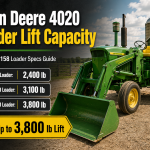
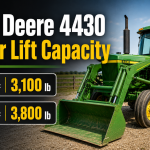
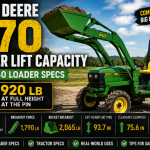
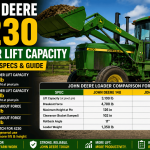
The John Deere 3020 loader lift capacity is 3,100 lb with a John Deere 148 loader, measured at full height at the pivot pin.
John Deere 3020 Loader Lift Capacity
Tractor Model
John Deere 3020
Best-Matched Loader
John Deere 148
Other Listed Loaders
John Deere 146 and John Deere 48
148 Loader Lift Capacity
3,100 lb at full height at pivot pin
148 Loader Breakout Force
4,700 lb
48 Loader Lift Capacity
2,400 lb at full height at pivot pin
48 Loader Breakout Force
3,600 lb
Hydraulic System
Closed-center hydraulics
Best Use
General farm loader work, feeding, cleanup, and material handling
What Loader Fits a John Deere 3020?
The John Deere 3020 is commonly listed with the John Deere 148, John Deere 146, and John Deere 48 front loaders. For most buyers, the John Deere 148 loader is the main one to look at because it gives strong lift capacity without being as excessive as larger loader swaps.
The confirmed 148 loader rating is 3,100 lb at full height at the pivot pin. The older 48 loader is lower at 2,400 lb at full height at the pivot pin.
Loader lift capacity is measured at the pivot pin. Real bucket-edge, bale spear, or pallet-fork lift is lower because the load sits farther forward.
Quick Loader Specs
3,100 lb148 Loader Lift
4,700 lb148 Breakout
2,400 lb48 Loader Lift
3,600 lb48 Breakout
John Deere 148 Loader Specs
Lift Capacity
3,100 lb at full height at pivot pin
Breakout Force
4,700 lb
Maximum Height at Pin
126 inches
Clearance with Bucket Dumped
102 inches
Clearance with Bucket Level
121 inches
Dump Reach
32 inches
Reach at Ground
68 inches
Dump Angle
38 degrees
Rollback Angle
11 degrees
Loader Weight
1,350 lb
John Deere 48 Loader Specs
Lift Capacity
2,400 lb at full height at pivot pin
Breakout Force
3,600 lb
Maximum Height at Pin
126 inches
Clearance with Bucket Dumped
104 inches
Dump Reach
26 inches
Reach at Ground
68 inches
Dump Angle
39 degrees
Rollback Angle
9 degrees
Loader Weight
1,220 lb
Loader Lift Capacity Comparison
JD 148
3,100 lb
JD 48
2,400 lb
Difference
700 lb
Is the John Deere 158 Loader Good for a 3020?
The John Deere 158 loader is often discussed as a possible swap, but it is not the clean factory-style match for the John Deere 3020. It is larger, taller, heavier, and better suited to bigger tractors.
For a John Deere 3020, the 148 loader is the smarter page target. The 158 is better treated as a comparison or caution section, not the main loader spec.
The 158 loader adds more front-end weight
It puts more stress on the front axle
It can make the tractor feel nose-heavy
Mounting and bracket compatibility must be checked carefully
The 148 is usually the better-balanced choice
Can a John Deere 3020 Lift Round Bales?
Yes, a John Deere 3020 with a 148 loader can handle many round bales, especially dry bales, but ballast and front-end condition matter heavily.
Dry bales are more realistic than wet bales
Rear ballast is mandatory
Bale spears reduce usable lift compared with pivot-pin ratings
Front tires, spindles, and axle wear matter on older tractors
Keep bales low while driving
Real-World Loader Performance
The John Deere 3020 works best with balanced loader jobs, not constant max-capacity lifting. The 148 loader gives useful lift while still being reasonable for the tractor size.
Bucket work feels stronger than pallet forks
Loaded rear tires improve stability
A rear blade or ballast box helps protect the front end
Hydraulic condition affects actual lift performance
Old pins, bushings, and mounts reduce loader accuracy
Best Loader for the John Deere 3020
The John Deere 148 loader is the best overall loader choice for the John Deere 3020. It has enough lift for farm work without being as oversized as a 158 swap.
Best Overall Loader
John Deere 148
Older Lighter Option
John Deere 48
Higher-Stress Swap
John Deere 158
Best Page Target
John Deere 3020 Loader Lift Capacity (148)
Loader Safety Tips
Always use rear ballast
Keep heavy loads low while moving
Avoid side slopes with raised loads
Inspect loader mounts and front axle regularly
Do not treat pivot-pin lift as pallet-fork capacity
Check hydraulic hoses, pins, and bushings often
Common Mistakes
Using 158 loader specs as if they are the normal 3020 setup
Confusing pivot-pin lift with usable fork lift
Running no ballast with heavy loads
Overloading the front axle
Buying a loader without checking brackets and mounts